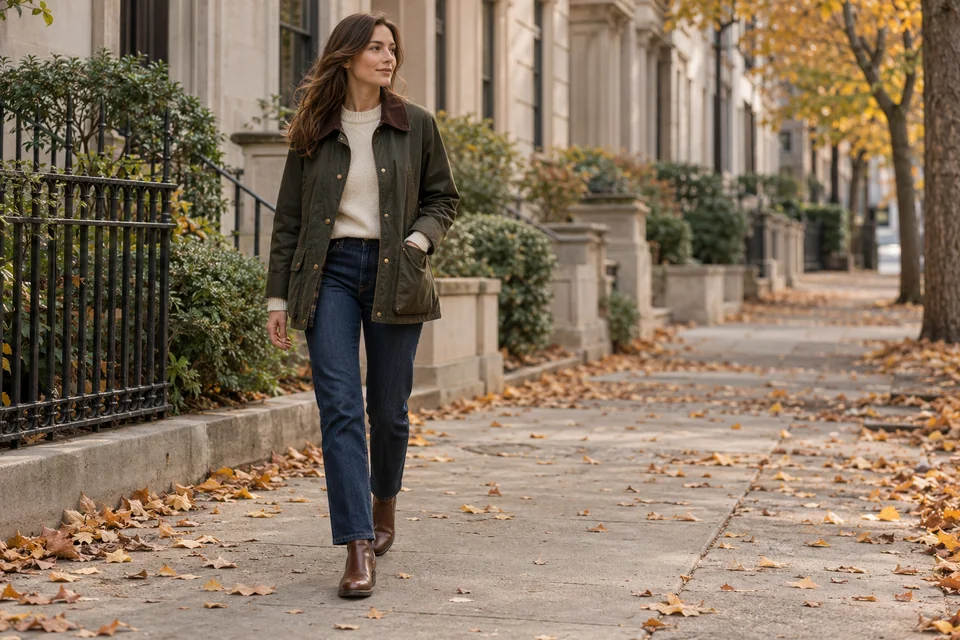
Start with the jacket’s job
A barn jacket is not a blazer pretending to be practical. Its roomy pockets, sturdy fabric and contrast collar bring a relaxed, outdoorsy note before you add anything else. That is useful when the day includes a walk, a commute, a market or changeable weather, but it means the rest of the outfit benefits from a clear job. Begin with the jacket you own: waxed cotton, canvas, quilted lining, corduroy collar, cropped shape or thigh length. The length and weight matter more than a label on the hanger.
Check fit with the layers you really use. You should be able to reach forward, sit down and close the jacket over a fine knit without the shoulders pulling. Sleeves can look casually long, but cuffs that cover your hands make keys, bags and coffee less convenient. If the jacket is substantial, reserve a little space underneath rather than forcing a bulky sweatshirt into it. A comfortable base layer and an optional light middle layer usually make a barn jacket more useful than a stack of thick fabrics.
Let one feature lead. A dark olive jacket with a brown corduroy collar already supplies color and texture, so an ivory knit, dark denim and brown boot have a simple supporting role. If your jacket is black, navy or tan, treat it much like a casual coat and build from the trousers or skirt you already wear most. The aim is not to disguise the jacket’s practical character; it is to make it look chosen for the day.
Use proportion, not tightness, to balance the shape
Because many barn jackets end around the hip and have useful volume through the body, the easiest partner is a lower half with a readable line. Straight jeans, slim-straight trousers, a midi skirt, a column dress or tapered chinos all give the jacket an anchor. Wide trousers can work too, especially with a shorter jacket, but make one point of the outfit clear: show a waistband, choose a fitted knit, or use a shoe with enough presence to hold the silhouette.
Nothing has to be tight. A relaxed Oxford shirt under a barn jacket feels easy when the hem does not bunch below the jacket and the collar is visible or deliberately tucked in. A fine crew-neck knit is an even simpler option because it gives the eye a clean area between collar and trousers. With a very boxy jacket, a long untucked sweatshirt that ends at the widest part of the hip can turn the whole look into one block. Try a shorter knit, a front tuck, a straighter trouser or an open jacket before deciding that the pieces do not work.
Test the outfit from the side as well as the front. The pocket bulk, bag strap and hem should not all land at the same point. If they do, move the bag higher, choose a smaller crossbody, or swap to a tote that sits away from the jacket’s pockets. Small changes like these preserve the jacket’s usefulness instead of treating it as a costume.
Build three everyday formulas before buying anything
For a weekend walk, start with dark olive barn jacket, ivory crew-neck knit, straight indigo jeans and brown ankle boots. The light knit makes the upper half feel open, while the jeans and boots can take pavement, a café queue and fallen leaves. On a mild day, replace the knit with a white heavyweight T-shirt and carry a fine layer in your bag. That substitution keeps the formula intact without pretending the weather is fixed.
For a relaxed office or studio, use a navy barn jacket over a pale blue poplin shirt, charcoal tailored trousers and black loafers. Shirt collar and trouser crease make the jacket feel intentional rather than unfinished. This is not a substitute for a blazer in a formal meeting, uniformed workplace or conservative client setting. When the dress code requires tailoring, wear tailoring. The point is to use a casual outer layer where it belongs, not to make it argue with the room.
For dinner after errands, try a chocolate or olive jacket with a black fine-knit top, dark midi skirt and pointed flat boots. The slimmer top and defined shoe give the jacket a contrast, while the skirt leaves enough movement for a real evening. If rain is likely, change to an ankle boot with a lower, stable heel and let comfort win. A useful outfit is one you do not need to manage once you have left home.
Choose shoes for the hem and the ground
Footwear decides whether a barn-jacket outfit feels grounded or accidentally heavy. Brown ankle boots are an easy match with indigo denim, olive, tan and chocolate because they repeat the warm note of a corduroy collar or leather buttons. Black boots make a sharper line with black trousers or a dark skirt. Clean low-profile sneakers lighten a canvas jacket and suit walking days; thick technical trainers may compete if the jacket already has visible pockets, tabs and quilting.
Loafers can bring polish to tailored trousers, cropped jeans and a midi skirt. Look at the hem before leaving: it should either meet the shoe cleanly or stop with a little daylight, not gather across the vamp. On wet ground, choose a sole with grip and enough toe room for socks. A delicate flat can be a beautiful indoor option, but it does not need to be the answer to a day spent on uneven pavement.
Try on the complete outfit and walk for five minutes. Does the jacket swing comfortably, do the trouser hems stay off the ground, and can you use the pockets without shifting the bag? Those practical answers matter more than whether every item belongs to the same imagined aesthetic.
Make color and texture do one job
Earthy barn jackets are easy because they connect with colors already common in a wardrobe. Olive sits well with ivory, cream, navy, charcoal, denim blue, burgundy and tobacco brown. Navy works with white, grey, stone, faded blue and rich red. Tan or tobacco jackets look softer with ecru and mid-blue and more graphic with black. You do not need exact matching; one quiet echo between boot, belt, bag or collar is usually enough.
Texture is just as useful. Waxed cotton beside soft merino, corduroy beside smooth poplin, and canvas beside dark denim create contrast without asking for a new color. Avoid making every surface rustic at once: a corduroy collar, heavy cable knit, distressed jeans, hiking boot and large suede bag can all be good separately but together may obscure the outline. Keep one or two tactile details and let the rest stay calm.
Before buying another layer, photograph two versions with pieces you already own. The Look Lens outfit analyzer can help you compare whether a tucked shirt or fine knit creates a clearer balance with your jacket. In the Look Lens virtual wardrobe, group the jacket with your real trousers, dresses and shoes so you can see which combinations serve weekday, travel and weekend plans. Use the comparison as a second view; your comfort and preference still make the decision.
Layer for weather without losing movement
A barn jacket works best as part of a small sequence. Start with a base that is comfortable indoors: tee, long-sleeve top, fine knit or shirt. Add a cardigan, thin fleece or overshirt only when the temperature makes it useful. Then put on the jacket and check whether your arms can move freely. If the middle layer creates tight shoulders or a crowded neck, choose a thinner one rather than sizing up the jacket blindly.
For a cool but dry morning, a merino crewneck under a canvas barn jacket is often enough. For wind, add a close scarf inside the collar rather than piling a giant scarf over the outside. For rain, check the fabric care and take an umbrella if the jacket is not designed for prolonged wet weather. A waxed or coated finish can shed a short shower, but it is not a promise that every seam, cuff and bag contents will stay dry.
Plan the jacket’s destination indoors. Can it go over a chair, fold over an arm or fit in the car without becoming a problem? This mundane question helps you choose a weight that works beyond the mirror. The best outer layer lets you adapt to the day rather than making the day revolve around it.
Avoid common barn-jacket mistakes
The common mistake is adding utility details everywhere: cargo trousers, a logo sweatshirt, technical backpack, hiking boot and a pocket-heavy jacket can make the outfit lose its line. Reduce one or two signals. Swap cargo trousers for straight jeans, use a plain knit, or choose a compact bag. You are not making the look less practical; you are making each practical piece easier to read.
Another mistake is confusing relaxed with unconsidered. A barn jacket over sleepwear-adjacent joggers may be exactly right for a quick dog walk, but it will not automatically feel ready for every coffee, gallery or workday. Change one supporting piece: structured trouser, clean tee, leather shoe or defined bag. That single adjustment can make the same jacket travel much further.
Finally, do not ignore scale. A very long jacket with a long tunic, full trouser and oversized tote can feel heavy even in beautiful colors. Show some ankle, choose a shorter top, or use a more compact bag. The goal is a shape you can move through, not a rigid formula.
Use the barn jacket as a helpful outer layer
Build three reliable versions: jeans and boots for a walking day, shirt and tailored trousers for a casual workplace, and fine knit with skirt or dark trousers for an evening plan. Once those work, change just one element at a time—the shoe, the knit color or the trouser shape—so you learn what your own jacket really supports.
For a quick final comparison before you leave, you can try Look Lens on Google Play and review two photographed versions of the outfit. Keep the simple principle: let the barn jacket solve the outer-layer problem, and let every other piece earn its place through comfort, proportion and the plan ahead.
Frequently asked questions
What should I wear under a barn jacket?
A fine knit, heavyweight tee, long-sleeve top or poplin shirt works well. Choose the weight by the weather, then make sure the jacket still closes and your shoulders move freely.
Can I wear a barn jacket to the office?
It can suit a relaxed workplace when paired with a crisp shirt, tailored trousers and polished shoes. For formal meetings or stricter dress codes, a blazer or tailored coat is the better choice.
Which trousers work best with a barn jacket?
Straight jeans, tapered chinos, tailored trousers and some wide trousers all work. With a wider trouser, use a shorter jacket, a visible waistband or a more defined shoe to keep the outline clear.
Are barn jackets only for autumn?
No. An unlined canvas version can work in mild spring weather over a tee, while a lined version works in cooler conditions with a fine knit. Choose the lining and layers for the temperature rather than the calendar.