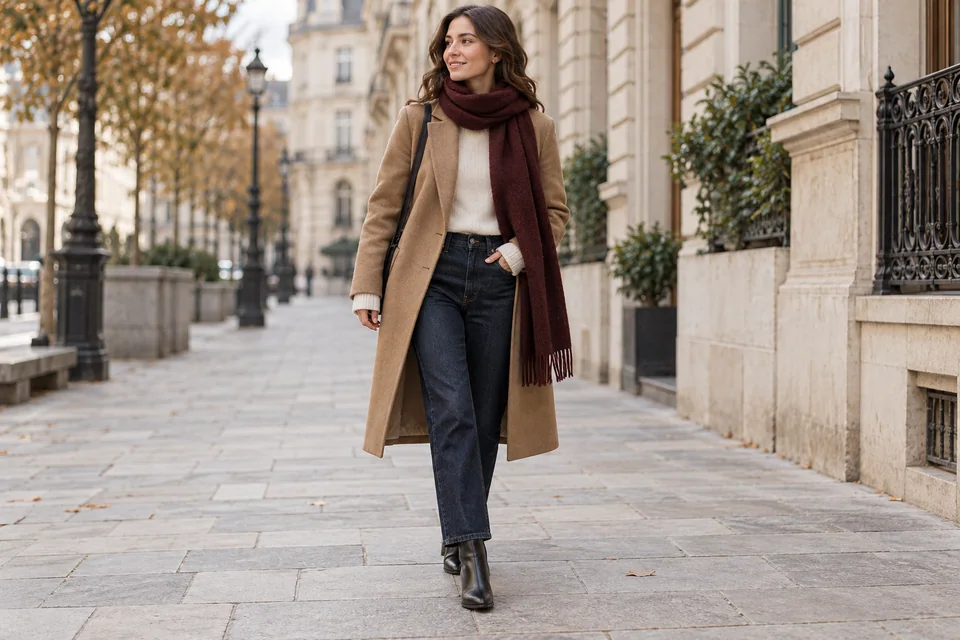
A scarf does more than make a coat warmer. It changes the focal point of an outfit, adds texture close to the face and can connect shoes, a bag or a knit that otherwise feel separate. That also explains why scarves sometimes look like an afterthought: the size is wrong for the collar, the color has no companion, or too much fabric is sitting in one place.
Start with the clothes you will actually wear that day. A thick wool scarf is useful on a cold walk but can feel crowded under a narrow blazer. A silk square looks sharp at dinner but will not replace a warm layer on a windy commute. These formulas help you choose a scarf for the plan, then wear it in a way that keeps the outfit clear rather than fussy.
Choose the scarf weight before the color
Match the scarf to the outermost layer, not just the temperature. A dense wool coat can handle a medium or heavy brushed-wool scarf because both fabrics have visual weight. A light trench, denim jacket or tailored blazer usually looks better with a fine wool, cotton-silk blend or narrow scarf. When a thin jacket meets a giant blanket scarf, the fabric can swallow the neckline and make the coat look smaller than it is.
Look at the collar as well. A high-neck puffer already creates volume around the face, so let a narrow scarf hang in one loop or tuck it inside instead of building a thick knot. A V-neck coat or simple crewneck knit leaves room for a relaxed drape. If you are wearing a crossbody bag, place the scarf first and let the strap sit over the outer layer rather than trapping the ends underneath it.
Texture is a practical tool. Smooth merino, cashmere or fine wool feels more polished with tailored trousers and leather shoes. Chunky ribbing, mohair or fringe makes a casual coat and denim feel softer. There is no need for every texture to match; one fuzzy scarf with a smooth wool coat works because the contrast is intentional. Two bulky, fluffy layers at the neck usually feel less controlled.
Use a simple drape for coats and long layers
The easiest scarf arrangement is a single loop around the neck with both ends hanging down at different but similar lengths. It gives a long coat a vertical line and stays comfortable when you take the coat off indoors. Try a burgundy wool scarf with a camel coat, cream knit, dark straight jeans and black ankle boots. The scarf supplies the rich color; the coat and knit keep the rest of the look calm.
For a more open coat, fold a long scarf once lengthwise, place it around your neck and pull the loose ends through the loop. Keep it relaxed instead of cinching it tightly. This is useful when there is wind or a train platform involved, and it prevents the scarf from sliding off one shoulder. If the coat has broad lapels, make the loop sit just below the collarbone so the lapels still show.
A scarf worn open should not end exactly at the widest point of your hips if that makes you feel cut across. Let the ends fall a little above or below that point, or tuck one end into the belt of a long coat. The aim is not to manufacture a perfect line; it is to stop a useful warm layer from breaking the outfit into unrelated blocks.
Wear a scarf with a blazer without adding bulk
With a blazer, treat the scarf as an accessory rather than insulation. A narrow silk, cotton or fine knit scarf can sit inside the neckline, drape once over the shoulders, or be folded into a small triangle at the neck. A navy blazer, white shirt, charcoal trousers and loafers becomes more personal with a fine striped scarf in navy, cream and a small accent color. Keep the pattern modest if the shirt is striped too; one visible pattern is usually enough.
A compact square scarf works particularly well when the blazer is worn indoors. Fold it diagonally, roll it loosely from the point upward, then tie a small side knot. Leave enough ease to move your head comfortably. If it feels costume-like, loosen the knot and let a small triangle show at the collar. You can also tie the square scarf to a structured bag instead, especially if you dislike fabric at your neck.
Skip the heavy scarf-plus-blazer combination unless the blazer is functioning as outerwear in mild weather. In that case, use a soft, flat scarf and carry a coat for the journey. A scarf cannot make a cold-weather outfit practical if the rest of the layers are too light; it should solve one problem, not pretend to solve all of them.
Build a color connection, not a perfect match
The most useful scarf colors are often the ones that bridge two pieces you already wear: burgundy with camel and dark denim, forest green with navy and cream, or a soft grey with black and charcoal. Repeating one note is enough. A burgundy scarf can echo a berry lip, dark-red socks or a small leather bag, but it does not require matching gloves, shoes and hat in the same shade.
If your coat is colorful, choose a quieter scarf in cream, charcoal, navy or a tone already inside the coat's pattern. If the coat is neutral, the scarf can take more visual space. A black coat with a cobalt, red or deep green scarf is direct and easy; a taupe coat with a muted plaid creates a softer effect. Check the combination in daylight because warm indoor lighting can make greys, camels and burgundies look closer than they are.
When two scarves seem plausible, take a quick full-length mirror photo. The Look Lens outfit analyzer can help you compare visible color balance and the way the scarf changes the upper half of the outfit. Use it as a second view, then choose the option that also works with the weather, your bag and the shoes you can walk in.
Style a small silk scarf for indoor outfits
A small silk or satin scarf does a different job from a wool scarf: it adds contrast, pattern or a finish to a simpler outfit. With a black knit dress and pointed flats, a printed square scarf tied loosely at the neck gives the dress a focal point without adding another garment. Keep the rest of the jewelry simple, especially if the print is bright or the scarf has a pronounced border.
You can also use a small scarf on a bag handle, through belt loops on high-rise jeans, or around a low ponytail. Each placement changes the balance. A bag tie is good when you want the color lower in the outfit; a neck tie brings attention upward; a hair tie is best when the neckline already has a collar or necklace. Choose one placement at a time so the scarf looks deliberate rather than scattered through the outfit.
For travel or a long workday, carry the silk scarf flat in a pouch and add it after your outer layers come off. That keeps it from being crushed under a wool scarf or caught in a coat zip. It also gives one neutral outfit a small evening switch without requiring a full change.
Solve common scarf problems
If a scarf keeps slipping, the issue may be the fabric rather than your knot. Smooth silk needs a smaller tie or a brooch-style scarf ring; slippery fine wool often stays better with one end tucked under a lapel. If the ends are wildly different lengths, remove the scarf and start again with the midpoint at the back of the neck. Small adjustments are faster than fighting the fabric all day.
If the scarf makes your upper body feel crowded, remove one layer of volume. Switch a giant knot for an open drape, choose a less bulky knit, or wear the scarf inside the coat. If you look washed out, move a clearer color closer to the face or trade pale beige for cream, rust, navy or a deeper neutral that has more contrast with your skin and hair.
Use the Look Lens virtual wardrobe to group your scarves with the coats, jackets and footwear you reach for most. Seeing the combinations together makes duplicate colors and missing practical options easier to spot, and helps you build three reliable formulas from pieces you already own.
Make scarves work harder in your wardrobe
One warm solid scarf, one smaller patterned square and one neutral fine layer cover many more situations than a stack of nearly identical scarves. The warm scarf handles walking and outerwear; the square updates simple indoor outfits; the fine option layers under blazers and trench coats. Store them where you can see the color and texture rather than burying them in a drawer, because the right one is easier to choose when it is visible beside your coat.
The best scarf styling is practical first: enough warmth, a neckline you can move in, and a color or texture that belongs somewhere else in the outfit. Begin with one simple drape, take note of the combinations that feel good on real days, and repeat them. For help turning the pieces you already own into more usable looks, get Look Lens on Google Play and plan from your own wardrobe.
Frequently asked questions
How do I wear a scarf with a coat?
Use a relaxed single loop or loose pull-through knot, keeping the coat collar visible. Match a heavier scarf to a substantial wool coat and a finer scarf to a lighter coat.
What scarf color goes with everything?
Deep navy, charcoal, cream and medium camel are versatile choices. Pick the one that connects best with the coats and shoes you wear most rather than searching for a universal shade.
Can I wear a scarf with a blazer?
Yes. Choose a narrow silk, cotton or fine knit scarf and keep the knot or drape flat so it fits the blazer collar without adding bulky outerwear volume.
Why does my scarf look too bulky?
The scarf may be too thick for the coat or knot. Use a lighter fabric, a looser drape or fewer wraps, and let the collar and lapels remain visible.