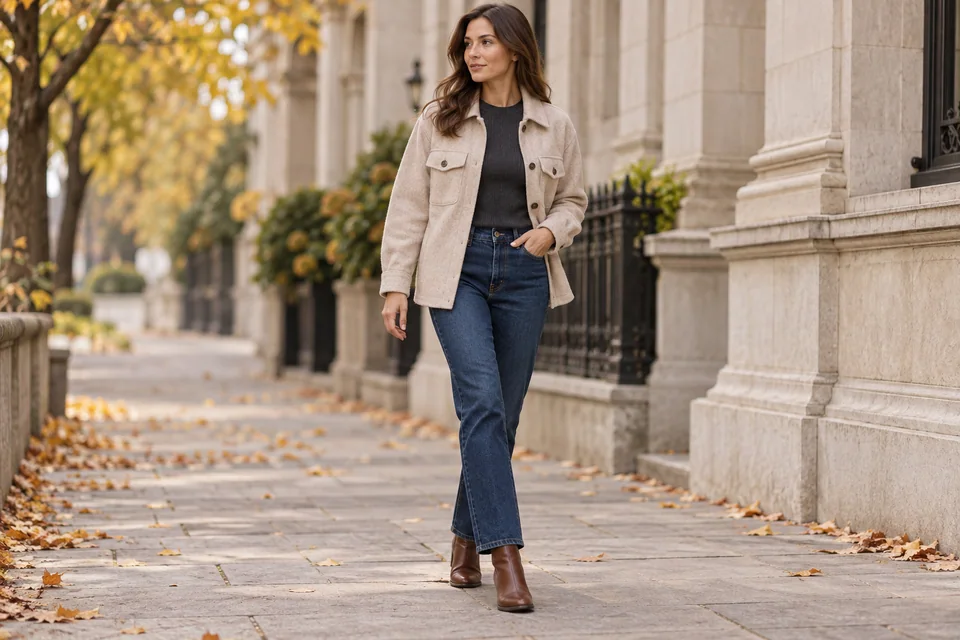
A shirt jacket, often called a shacket, earns its place in a wardrobe because it handles the in-between part of a day. It is more relaxed than a blazer, less precious than a wool coat, and more useful than a shirt you only wear tucked in. The challenge is that its extra fabric can make an outfit feel wide or unfinished if everything beneath it is equally loose.
Start by treating the shirt jacket as a third piece. Put together a comfortable base you would happily wear indoors, then add the layer for warmth, texture, or a little shape. A ribbed tee and jeans, a fine knit and trousers, or a fitted top with a midi skirt are all strong foundations. The formulas below show how to make that idea work for ordinary plans instead of saving it for a single autumn photo.
Choose the shirt jacket for the job it needs to do
Not every shirt jacket behaves the same way. A brushed plaid or sherpa-lined version is casual and has visual volume; it is ideal for a walk, travel day, or weekend coffee. A solid twill, wool-blend, denim, or corduroy version has a cleaner line and can move toward smart casual. Look at the shoulders, hem, and fabric before deciding what to wear with it.
If you expect to take it on and off through the day, choose a layer that is easy to hold or fold without losing its shape. If you plan to keep it on indoors, a lighter cotton or twill version is easier than a thick fleece. A long shirt jacket can be useful with leggings and boots, while a cropped or hip-length style naturally works with high-rise denim and skirts. The practical question is not whether it is trendy; it is whether the weight and length make sense for the temperature and your plans.
Build a clear base layer first
The easiest way to avoid a bulky silhouette is to make the inside layer simpler than the outside one. Try a cream fitted T-shirt under an olive twill shirt jacket, or a charcoal fine-knit top under an oatmeal wool blend. The contrast in fit gives the jacket room to be relaxed without making the whole outfit feel shapeless.
This does not mean every top must be tight. A regular-fit T-shirt, slim button-front cardigan, or lightweight sweatshirt can work well. Just avoid combining a very oversized shirt jacket, a thick loose jumper, and wide trousers unless you deliberately reveal a waist or use a shorter jacket. When in doubt, button the jacket once at the middle or half-tuck the base layer; either move gives the eye a reference point.
Pair it with jeans for the most reliable everyday outfit
Dark straight-leg jeans, a fitted tee, and ankle boots are a dependable shirt-jacket formula because each piece has a different job. The tee keeps the middle clean, denim gives the look structure, and boots carry enough visual weight for the jacket. Choose a neutral jacket such as camel, navy, ecru, charcoal, or olive if you want to repeat it with several jeans washes.
For a lighter daytime version, use blue straight jeans, a white T-shirt, a washed denim or khaki shirt jacket, and clean leather sneakers. For a cooler day, swap the tee for a thin turtleneck and the sneakers for brown or black boots. If your jeans are wide-leg, keep the base layer closer to the body or use a shorter jacket; two large shapes can look good, but they need a deliberate contrast somewhere.
Use tailored trousers to make the layer feel smarter
A shirt jacket can stand in for a blazer at a relaxed office, lunch meeting, or gallery visit when the rest of the outfit has enough polish. Start with black, charcoal, navy, or chocolate tailored trousers. Add a fine-gauge knit or a crisp crew-neck top, then use a solid shirt jacket with a more structured collar. Loafers, sleek trainers, or low block-heel boots finish the look without turning it into formal suiting.
Keep the color palette edited. Navy jacket, cream knit, black trousers, and black loafers is simple but not flat because the fabrics differ. A tobacco corduroy shirt jacket, black top, and stone trousers create a warmer version. If the jacket has large patch pockets, big buttons, or a bold plaid, let the trousers be plain; the jacket already provides the visual story.
Balance a skirt or dress with matte texture
A shirt jacket is useful when you want to wear a skirt or dress in weather that is too cool for bare shoulders but not cold enough for a heavy coat. Over a black fitted top and a satin midi skirt, a camel, denim, or dark-green jacket adds a grounded, matte texture. Pointed ankle boots, loafers, or clean sneakers will decide whether the result feels like dinner, daytime, or a long walk.
With a knit dress, choose a shirt jacket that ends near the widest part of the hip or is deliberately longer. A very short boxy layer over a voluminous dress can cut the silhouette in an awkward place. With a mini skirt, an oversized shirt jacket can add welcome coverage; with a midi skirt, a slightly more defined jacket or a part-buttoned front often keeps the waist visible. Try the outfit sitting down before committing to it for a day out.
Use shoes to set the level of casualness
Shoes do more than finish this outfit. They tell the shirt jacket whether it is working as a light coat, an overshirt, or a smart-casual layer. Low-profile sneakers keep a plaid or denim version easy for errands. Brown ankle boots add warmth and work especially well with ecru, olive, rust, and dark denim. Loafers make a solid wool or twill style feel more polished with trousers.
For evening, a pointed boot or sleek ballet flat can give a relaxed jacket a sharper counterpoint. Avoid automatically choosing the most delicate shoe available: a heavy shirt jacket over a thin strappy sandal can leave the outfit visually top-heavy in cool weather. Instead, repeat one element of the shoe elsewhere, such as brown boots with a brown belt or black loafers with a black bag, so the outfit has a quiet through-line.
Make room for weather, walking, and layers
The shirt jacket is strongest when it solves a real temperature problem. On a mild day, a tank or T-shirt underneath may be enough. On a chilly commute, use a thin merino knit or long-sleeve base, then save the puffer or trench for outdoors if needed. The aim is to avoid stuffing a bulky hoodie under a close-cut jacket simply because the morning was cold; that combination can feel restrictive by lunch.
Consider movement too. A cropped style is easy for driving and sitting, while a longer style is useful if you walk a lot or pair it with leggings. Roll sleeves once if they cover your hands, and check that the jacket does not pull across the upper back when you reach for a bag. Small comfort adjustments make a repeated outfit feel genuinely wearable, not like a look you tolerate for the mirror.
Try seven repeatable shirt-jacket outfits
Use these as formulas, then replace colors with the pieces you already own:
- Weekend: olive twill shirt jacket, white ribbed tee, faded straight jeans, and white leather sneakers.
- Cool coffee run: oatmeal wool shirt jacket, charcoal knit, dark jeans, and brown ankle boots.
- Casual office: navy shirt jacket, cream fine knit, black tailored trousers, and loafers.
- Early dinner: camel shirt jacket, black fitted top, satin midi skirt, and pointed boots.
- Travel day: long checked shirt jacket, black tank, soft black trousers, and supportive sneakers.
- Warm afternoon: light denim shirt jacket over a striped tee, ecru jeans, and loafers.
- Leggings formula: hip-covering charcoal shirt jacket, long-sleeve top, black leggings, and lug-sole boots.
If you are deciding between two versions, photograph each in full length. The Look Lens AI Outfit Analyzer can help you compare the visible balance of the layers, shoes, and colors, especially when one jacket feels good on a hanger but uncertain on your body. Treat the feedback as a practical second look, not a rule: your comfort and the actual weather matter more than a perfect formula.
Keep the outfit personal rather than overly styled
The appeal of a shirt jacket is its ease, so it does not need every possible accessory. Pick one useful detail: a leather belt, small hoop earrings, a scarf that fits in your bag, or a structured tote. Let a plaid jacket be the pattern, or let a textured corduroy version be the texture. Adding a loud print, oversized bag, statement shoe, and large scarf at once can make a straightforward layer work much harder than it needs to.
Before leaving, ask three questions: can you remove the jacket without the base outfit collapsing, can you walk in the shoes, and does the jacket add a purpose? If the answers are yes, you have a flexible outfit rather than a seasonal costume. To compare the jacket with trousers, skirts, and shoes you already own, use the Look Lens virtual wardrobe as a simple planning space. For outfit ideas on the go, get Look Lens on Google Play.
Frequently asked questions
What should I wear under a shirt jacket?
A fitted T-shirt, ribbed tank, fine knit, or close-fitting long-sleeve top is an easy starting point. It creates a clean layer under the shirt jacket and leaves room to adjust for temperature.
Should a shirt jacket be worn open or buttoned?
Wear it open when you want the base layer and vertical line to show. Button it partway or fully when the jacket is light enough to read as a top; keep the bottoms simpler so the outfit does not become boxy.
What trousers go with a shirt jacket?
Straight jeans, tapered trousers, relaxed tailored pants, and leggings with a longer shirt jacket can all work. Match the trouser volume to the jacket: when both are roomy, use a fitted base or visible waist to add definition.
Can I wear a shirt jacket to work?
In a casual workplace, choose a solid-color, structured style over a fine knit or shirt with tailored trousers and loafers. A very oversized plaid version usually reads more weekend than office.