Start with the cargo pant, not the accessories
Cargo pants already carry visual information: side pockets, seams, a utility fabric and often a relaxed leg. That is why the easiest outfits do not try to make every other item equally noticeable. Begin with the pair you actually own. Is it a straight leg that lands near the shoe, a tapered cuff, a wide cotton trouser or a softer drawstring version? The answer guides the top length, shoe weight and outer layer better than a generic rule about dressing up or down.
Fit comes before styling. The waistband should stay comfortable when you sit, the pockets should lie reasonably flat, and the hem should not collect under your heel. A looser leg is not a problem; fabric that twists, drags or needs constant pulling is. Try the trousers with the footwear you will use most. A pair that works with a flat sneaker may suddenly be too long with a slender loafer, and a cuff that feels neat indoors may catch rain outside.
Then decide what role the cargos play. Olive, black, stone and navy are easy bases because they can behave like denim or chinos. Camouflage, large contrast pockets, shiny nylon or very wide legs are stronger statements, so give them simpler partners. This is not about making the garment disappear. It is about letting one useful detail lead instead of making an outfit compete with itself.
Balance volume with the top without squeezing yourself into it
Because cargo pants often have width and pockets below the waist, a top with a readable shape usually helps. A fine crew-neck knit, ribbed tank, plain T-shirt, close-fitting shirt or compact cardigan is an easy starting point. That does not mean every top must be tight. A relaxed Oxford shirt can work when it is partially tucked, has rolled sleeves, or ends at a point that lets the waistband remain visible. The goal is a direction for the eye, not a narrow silhouette.
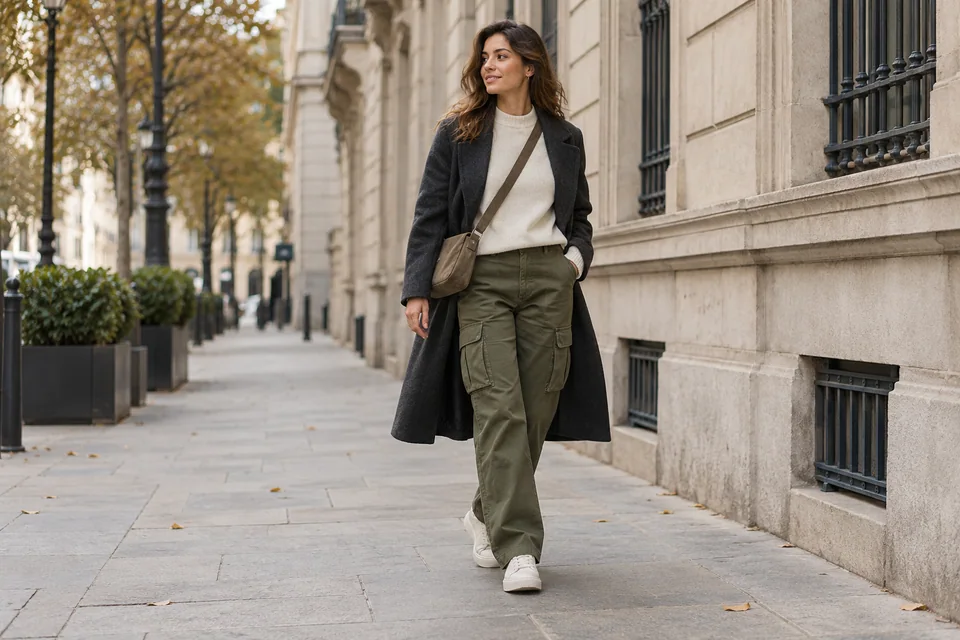
For a low-effort day, try olive straight-leg cargos, an ivory fine-knit sweater, off-white sneakers and a charcoal coat. The knit has enough texture to feel intentional but does not fight the pockets. For warmer weather, swap it for a white heavyweight T-shirt and leave the coat behind. A small crossbody bag is useful for the walk; a huge technical backpack can make an already utilitarian outfit feel crowded, so choose it only when you need the capacity.
With wide cargos, watch the top length. A long sweatshirt ending at the widest part of the hip can make the whole look feel like one unbroken block. A shorter sweatshirt, a front tuck, an open overshirt over a plain tank, or a longer coat worn open creates a clearer vertical line. If you love an oversized top, keep one other detail precise: a clean cuff, a defined waist, a slimmer shoe or a compact bag.
Build cargo outfits for real plans, not one imaginary occasion
Cargo pants are at their best when they match a day with movement. For coffee, errands or a museum, use a stable formula: straight olive cargos, a cream sweater, simple sneakers and a midweight coat. The sweater keeps the upper half quiet, and the shoe can handle stairs and pavement. If your coat is long, leave it open enough to show the waistband; closing it is sensible in wind, but a fully closed coat can hide the outfit without making it wrong.
For a relaxed office where casual trousers are accepted, a tapered black pair is the easiest route. Add a white poplin shirt, navy blazer and black leather loafers. The shirt’s collar and the shoe’s finish add structure, while the cargo pockets keep the outfit less formal than tailored trousers. Check your workplace before relying on this formula. If a client meeting, uniform policy or conservative dress code calls for classic trousers, choose them instead of trying to make cargos prove a point.
For dinner, use contrast rather than more decoration. Dark olive cargos, a black fitted top, cropped leather jacket and pointed ankle boots make the utility fabric feel purposeful. A small shoulder bag and one metal detail are enough. If the restaurant involves a long walk, change the pointed boot for a low block heel or polished sneaker. A successful evening outfit is still one you can get through the journey in.
For a weekend plan in unpredictable weather, choose cargo fabric and pockets as useful features, not theatrical ones. A long-sleeve tee, light overshirt and water-resistant jacket can work with tapered cargos and trail-inspired sneakers. Keep the palette to two neutrals plus one accent, such as stone, charcoal and olive. That makes a practical outfit feel calm even when the layers come on and off.
Choose shoes by hem, distance and ground
The best shoe depends on the cargo hem. Straight or wide legs often look balanced with low-profile sneakers, sturdy loafers, ankle boots or a small platform that keeps the fabric off the ground. Tapered or cuffed cargos can take a cleaner sneaker, ballet flat, slim boot or sandal in warm weather. Instead of choosing a shoe because it is theoretically fashionable, put the outfit on and walk around your home: does the hem catch, do the pockets pull, and can you climb stairs naturally?
White or off-white sneakers keep olive, black and stone cargos light. Black leather loafers add polish to a tapered pair but can feel too formal beside shiny nylon and exaggerated pockets. Ankle boots create a stronger base on cool or wet days, especially when the trouser hem skims the boot rather than bunching over it. Sandals are possible with lightweight cotton cargos, but ensure the hem is far from the pavement and choose a plan that does not require long, uncomfortable walking.
Color can connect the shoe without becoming a matching exercise. Black cargos with black boots create a continuous lower line. Olive cargos with cream sneakers pick up an ivory knit. Brown leather boots can work with stone or dark green trousers if a belt, bag strap or coat button quietly repeats the warm tone. You do not need every accessory in the same color. One echo is usually enough.
Use color and texture to make utility feel intentional
Think of cargo pants as the textured or detailed element in a restrained palette. Olive works naturally with ivory, navy, charcoal, black, pale blue, burgundy and medium denim. Black pairs well with white poplin, gray knit, washed blue denim and saturated accessories. Stone or beige cargos can be softened with cream and tobacco or sharpened with black and navy. The exact shade matters less than the contrast in depth: pale trousers with a pale top may need a dark shoe, belt or jacket to create definition.
Texture is often more useful than a new color. Matte cotton cargos look good with fine merino, crisp poplin, brushed wool, smooth leather or clean canvas. A satin top can create an evening contrast, but then keep the shoes and jewelry minimal. If the cargos are already glossy, heavily distressed or printed, choose calmer cotton, wool and matte leather around them. One textural contrast keeps an outfit interesting; five competing finishes make it hard to see the proportions.
Before buying an extra layer, test the pieces you already have in a few combinations. Use the Look Lens outfit analyzer to compare a front-tucked shirt with the same shirt worn loose, or to ask a focused question about shoe weight and color balance. In the Look Lens virtual wardrobe, grouping your cargo pants with real knits, shirts, coats and shoes can show whether the pair works for several kinds of days. These comparisons are useful information; comfort and personal preference still make the decision.
Avoid common cargo-pant mistakes with small adjustments
The most common problem is treating every piece as utilitarian at once: cargo pockets, logo sweatshirt, technical jacket, oversized backpack, chunky shoe and a cap may all be useful separately, but together can erase the outfit’s shape. Remove or simplify one or two signals. A plain tee instead of a graphic one, a wool coat instead of a second technical layer, or a clean sneaker instead of a heavily detailed shoe often does enough.
Another problem is forcing cargos into settings where their relaxed character is not useful. A cargo pant can be polished, but it does not replace formal dress trousers for every interview, ceremony or strict workplace. Let the event, not a trend, decide. For an everyday office, choose a tidy tapered pair with small pockets and a crisp shirt. For a formal event, choose the appropriate tailored trouser and save your cargos for the travel or weekend part of the day.
Finally, do a movement check. Sit down, bend, reach into a pocket, walk for five minutes and look at the outfit from the side. If the shirt rides up, the waistband pinches, the hem drags or the shoes need breaking in, change one item now. Clothes that work in a still mirror can fail on a commute. The practical point of cargo pants is freedom to move, so build around that advantage.
Keep three cargo formulas ready, then change one variable
Start with three dependable combinations: a walking-day formula with a knit and sneakers, a relaxed-office version with a shirt and blazer, and an evening contrast with a compact top and defined shoe. Once those are reliable, vary only one element at a time: change olive to black, sneakers to loafers, or a coat to an overshirt. You will learn what your pair actually supports without turning every morning into a styling experiment.
For a quick last look before leaving, you can try Look Lens on Google Play and compare two versions of an outfit you have photographed. Keep the useful principle in view: let the cargo pants provide the detail, give the rest of the look a clear job, and dress for the distance and setting ahead.
Frequently asked questions
What tops look best with cargo pants?
Fine knits, plain T-shirts, fitted tanks, crisp shirts and compact cardigans are useful because they give the lower-half volume a clear counterpoint. A relaxed shirt also works when its length or tuck keeps the waistband visible.
Can cargo pants work for an office?
They can in a casual or creative workplace. Choose a tidy tapered pair, a shirt or fine knit, and polished shoes; use tailored trousers when the dress code or event is more formal.
What shoes should I wear with cargo pants?
Match the shoe to the hem and your plan. Low-profile sneakers, loafers, ankle boots and some flats work well; walk in the complete outfit to check that the fabric does not drag or catch.
How do I make cargo pants look less bulky?
Let one part of the upper half or outer layer have a readable shape, keep the color palette calm, and avoid piling several technical or oversized items together. A shorter top, open coat or defined shoe can clarify proportion.