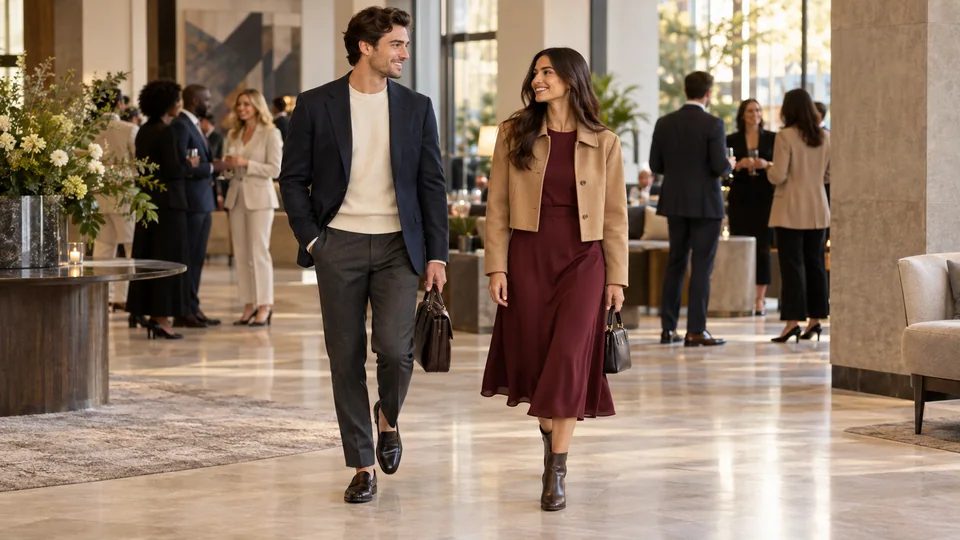
A networking event outfit has a quiet job: it should help you feel prepared without becoming the thing you keep thinking about. Whether the event is a conference reception, a professional association mixer, an alumni gathering or a small industry talk, you will likely be standing, introducing yourself, carrying a drink or notebook, and moving between conversations. The most useful outfit is therefore a polished version of clothes you already know you can wear comfortably.
There is no single networking uniform. A creative studio, a finance conference and a local founders’ meetup may all have different visual languages. Rather than trying to guess a rigid dress code, aim for a clear, tidy base and adjust one level upward from the ordinary workday. Good fit, clean shoes, a considered layer and a bag that leaves your hands free do more than a trend-led look that feels unfamiliar.
Read the room before you dress
Start with the invitation, venue and timing. “Cocktail reception,” “industry forum,” “open house” and “casual mixer” signal different levels of formality. Look at the host’s website or recent event photos if they are available, then choose an outfit that belongs in that setting without looking like you borrowed a costume. When in doubt, smart business casual is usually a flexible middle ground: tailored trousers or neat denim, a fine knit, shirt, blouse or simple dress, plus a jacket or structured cardigan.
Location matters as much as the label. A hotel lobby, gallery or restaurant may call for more polish than a daytime coworking-space talk. An outdoor event may need a real coat and shoes that manage pavement or grass. If you travel by public transport or will walk several blocks, build around the shoes first. Feeling steady on your feet makes it easier to move through a room and greet people naturally.
Build a reliable professional base
Begin with a silhouette you do not need to adjust. For many people, that is straight or wide-leg trousers with a tucked tee, knit or button-down. Others may prefer a midi dress with a cropped jacket, a skirt with an uncomplicated top, or dark neat denim with a blazer. The key is intention rather than formality: trousers should sit comfortably when you stand and sit, a neckline should not need constant checking, and sleeves should let you reach for a handshake or business card easily.
Choose a restrained base color, then add one warmer or more personal note. Navy and ivory, charcoal and pale blue, chocolate and cream, black and burgundy, or olive and soft pink are all easy combinations. A strong color can work too, especially in a simple shape. What often looks less convincing is several competing signals at once: a loud print, very high shoes, an oversized bag and statement jewelry all asking for attention. Pick one focal point and let the rest support it.
Use layers to set the level of polish
A layer is the quickest way to adapt familiar clothes to a networking setting. A navy blazer can sharpen a fine-gauge sweater and trousers; an unstructured jacket can make a simple dress feel ready for an evening reception; a long cardigan can soften a crisp shirt without making it casual. Choose a layer that still looks good when open, because indoor rooms often warm up once people arrive.
Think about proportion. A cropped jacket can define the waist over a midi dress or high-rise trousers. A slightly longer blazer creates a clean line with a slim knit and straight trousers. If your trousers are wide, a closer-fitting top or a light tuck keeps the outfit from feeling swamped. Before leaving, a quick full-length look through Look Lens outfit analysis can help you assess whether your layer, shoe and bag feel balanced together. Use it as a practical second view, not a rulebook.
Choose shoes and a bag for real conversations
Networking can involve more standing than expected, so wear shoes you have already tested for a few hours. Loafers, clean low-profile sneakers where the setting is relaxed, low boots, supportive flats and low block heels are useful options. A new shoe may look excellent for ten minutes and become distracting by the second conversation. If you love a higher heel, choose the pair that feels stable on stairs and on the walk from transport.
A compact crossbody, shoulder bag or structured small tote is easier than a bag that keeps sliding off your arm. It should hold the essentials without forcing you to balance a large laptop bag, coat and drink at once. Bring what you will genuinely use: phone, cardholder, keys, lip balm, a pen and perhaps a small notebook. If the event requires materials or a laptop, a tidy work bag plus a hands-free smaller bag may be more practical than stuffing everything into one oversized tote.
Try four easy outfit formulas
For a daytime professional talk, wear charcoal trousers, an ivory knit, loafers and a navy blazer. It is comfortable enough for commuting and polished enough for introductions afterward. For a creative mixer, try dark straight jeans, a clean T-shirt or knit, a textured jacket and ankle boots; add a small earring or patterned scarf rather than several bold pieces.
For an evening reception, a burgundy or deep green midi dress with a cropped camel jacket and low boots is composed without feeling overly formal. A fourth formula is a monochrome column: black or navy trousers, a matching fine top and a jacket in a nearby tone, finished with a contrasting leather shoe or bag. If you want to compare versions from your own closet, add your dependable pieces to the Look Lens virtual wardrobe and group them by setting. You may find that a jacket or shoe you already own completes several combinations.
Finish with small details that feel prepared
Do a five-minute check before you leave. Is the outfit clean and comfortable when seated? Can you remove your outer layer without losing the look? Are your shoes right for the route and the venue? Is your phone easy to reach without holding a bag in your hand? These practical questions are more useful than trying to make the outfit communicate your entire professional identity at once.
Grooming and accessories can stay simple. A lint roller, a clean pair of glasses, a jacket with empty pockets and a small piece of jewelry you do not fidget with are enough. If you wear fragrance, keep it light because events are shared spaces. The best detail is one that makes you feel like yourself rather than one you need to explain.
The takeaway: wear support, not armor
A good networking outfit supports the person you are already bringing to the room. It gives you a professional baseline, lets you move comfortably and leaves space for your conversation to lead. Start with clothes that fit, add a purposeful layer, choose tested shoes and keep one personal detail. That is plenty of preparation for most professional events.
Save the formula that felt easy and change just one element next time: a different knit, a brighter bag or a smarter shoe. If you would like help comparing those familiar options before your next event, try Look Lens on Google Play and start with the clothes already in your wardrobe.
Frequently asked questions
What is the safest thing to wear to a networking event?
Smart business casual is a dependable starting point: neat trousers or dark denim, a polished top, comfortable shoes and a jacket or structured cardigan. Adjust it upward when the invitation or venue is more formal.
Can I wear jeans to a networking event?
Often, yes. Choose dark, clean jeans without heavy distressing and pair them with a knit, shirt, blazer or polished shoe. For a formal conference or evening reception, trousers or a dress may be the easier choice.
Should I wear a blazer to a networking mixer?
A blazer is useful but not mandatory. It is a flexible way to add structure, especially for a hotel, conference or professional-services setting. A smart jacket, crisp cardigan or well-cut overshirt can work in more relaxed rooms.
What bag should I bring to a networking event?
Choose a compact bag with a secure closure that leaves at least one hand free. Bring only essentials unless the event requires a laptop or documents, in which case a tidy work bag is more useful than an oversized everyday tote.