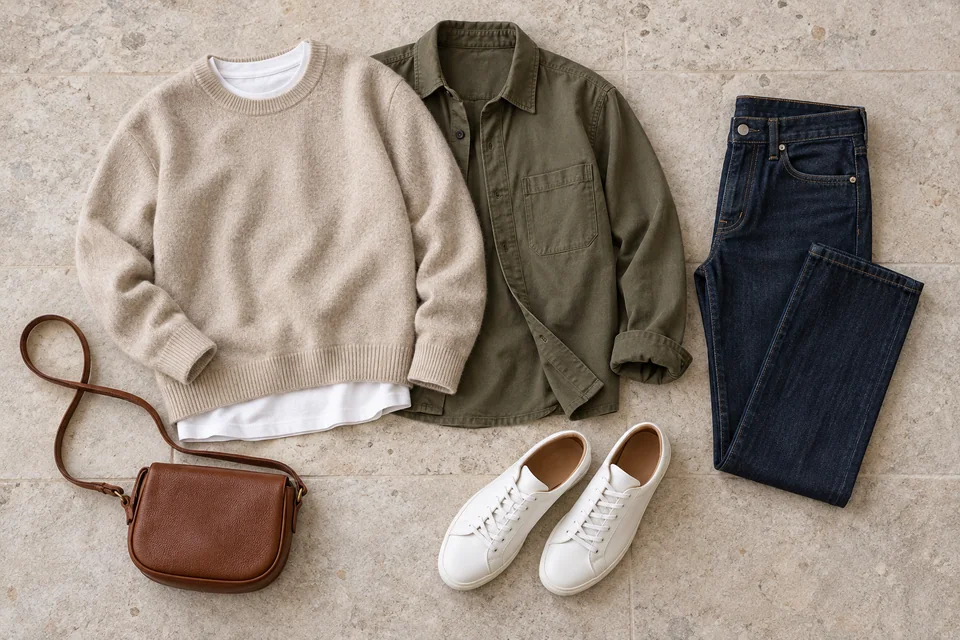
Fifteen degrees Celsius can be the most misleading point on a forecast. A bright afternoon may feel pleasantly mild, while a shaded commute, a breeze, rain or an air-conditioned room can make the same number feel much cooler. The answer is not a bulky outfit; it is an outfit with a useful temperature range.
Build from a base you would be happy to wear indoors, then add one layer that is easy to remove, carry or tie around your waist. Jeans, trousers, a midi skirt, a light knit, an overshirt, a trench, sneakers and ankle boots all have a place here. The right combination depends less on a universal rule and more on wind, rain, transport and how much of the day you will spend walking.
Read the day, not just the number
Before choosing clothes, look beyond the high temperature. A forecast of 15°C at noon can sit beside a much cooler morning, a damp evening or a strong wind. If you are leaving early, waiting outdoors, taking public transport or walking twenty minutes, dress for those exposed parts of the day rather than the warmest hour. A thin layer you can remove is usually more useful than a thick sweater you must wear all day.
Rain changes the decision as much as temperature. A short water-resistant jacket, closed shoes with a secure sole and a bag that keeps essentials protected can make a wet 15°C day feel straightforward. In dry weather, a cotton overshirt, denim jacket, cardigan or light trench gives similar flexibility. If you will mostly be in a warm office, make the inner layer a finished outfit rather than treating it as underwear for your coat.
Also notice your personal comfort pattern. Someone who runs warm may choose a tee and light jacket; someone who feels cold in the morning may prefer a fine knit over a cotton tee. Both can be appropriate at 15°C. The useful goal is to avoid being locked into one temperature setting.
Start with a breathable base
A breathable base keeps the outfit comfortable when the sun appears or you move between indoors and outdoors. A T-shirt, ribbed top, lightweight long-sleeve tee, cotton shirt or fine merino-style knit is more adaptable than a very heavy sweatshirt. Choose a layer that works on its own in a café, classroom or office, then let your outer layer do the weather work.
For casual days, a white or striped tee with straight denim gives you a simple foundation for an overshirt, cardigan or jacket. For a neater setting, use a fine knit with tailored trousers, or a shirt beneath a relaxed blazer or trench. A long-sleeve jersey dress can work too, especially with a jacket you can remove and boots or sneakers you know you can walk in.
Fabric matters more than an outfit label. Cotton, fine wool, light denim, poplin and smooth knits offer some warmth without trapping too much heat. Very thick fleece, a padded coat or multiple bulky knits can feel excessive once you are indoors. If the air feels damp, choose a base that is not so thin that it leaves you cold as soon as the wind picks up.
Choose one removable layer with a job
Your second layer should solve a real problem: wind, light rain, a cool commute or a sharper dress code. An olive or navy overshirt is excellent for errands because it is light, can be buttoned when needed and looks intentional over a tee. A denim jacket adds structure to dresses, skirts and wide-leg trousers. A cardigan is softer for an office or café, while a trench gives a more polished line and helps with drizzle.
Keep the proportions clear. If the base is loose, choose a jacket with enough shape to show where your shoulders and waist are. If you wear wide trousers or a flowing skirt, a shorter jacket, tucked top or belt can keep the outfit from becoming one large block. Conversely, a slim base can take a relaxed overshirt or cardigan easily. You do not need every piece to be fitted; you only need one visible point of structure.
For a simple home-closet test, put the layer on and off twice before leaving. Can you carry it without resenting it? Does the inner outfit still feel complete? Can you sit, drive or take a crowded train without constantly arranging the sleeves? Those small tests reveal whether a layer is genuinely useful rather than just photogenic.
Pick bottoms, socks and coverage for your route
Straight or relaxed jeans are a reliable 15°C choice because they offer a little wind protection without becoming heavy. Cotton twill trousers, soft tailored trousers and chinos work well when you need a more polished finish. If you prefer a skirt or dress, a midi length with ankle boots, sneakers or loafers is an easy middle ground. Add opaque tights if you know you will be outside in the morning or evening, or skip them when the day is dry and you tend to run warm.
Do not overlook socks. A thin cotton sock with sneakers is often enough for a mild dry day; a slightly warmer sock can make loafers and boots much more comfortable when the pavement is cold or damp. Very low socks can leave the ankle exposed to a draft, while a visible sock can become a deliberate detail when it repeats a color from your knit, bag or jacket.
Consider movement before committing to a skirt, cropped trouser or wide hem. A rainy pavement and a long walk can make dragging fabric or bare feet less appealing than it looked in the mirror. The best substitution is often simple: trade the delicate shoe for a closed sneaker or boot, add tights, or choose a slightly shorter hem that clears the ground.
Choose shoes and small weather protection early
At 15°C, footwear often decides whether you are comfortable. Clean leather or canvas sneakers suit a casual day with lots of steps. Loafers work for a neater office outfit if they fit securely and the forecast is dry. Ankle boots are useful for wind, rain or a skirt-and-knit combination, especially when they have a sole you have already tested on wet ground. There is no prize for choosing a shoe that requires careful walking.
Bring practical protection only when it has a purpose. A compact umbrella is useful if rain is likely; sunglasses can help on a bright day; a light scarf can make an exposed commute much more comfortable. Skip the heavy accessories when the forecast is stable. One small addition is easier to manage than turning a mild day into a full winter uniform.
If you are uncertain between two shoes, wear the pair that works with your longest walk. That decision gives the rest of the outfit more freedom. You can make sneakers feel considered by keeping them clean and repeating white or cream in the top; you can make boots feel lighter by pairing them with an open overshirt or a soft knit instead of a heavy coat.
Three 15°C outfit formulas to adapt
Jeans, tee and overshirt for errands
Start with a white T-shirt, dark straight jeans and clean sneakers. Add an olive, camel or navy overshirt and a small crossbody bag. The outfit works because each item has a practical job: the tee breathes indoors, the overshirt handles a cooler start, the jeans are easy to move in and the sneakers support walking. For rain, swap the overshirt for a short water-resistant jacket and choose a sneaker with less exposed mesh.
Fine knit, trousers and trench for work
Pair a fine navy, charcoal, cream or burgundy knit with stone, black or dark-navy trousers. A light trench or unstructured blazer adds shape, while loafers, low boots or clean leather sneakers set the formality. This formula is useful when your office temperature is unpredictable because the knit looks finished after the outer layer comes off. If the morning is colder, add a thin cotton tee beneath the knit rather than a bulky extra sweater.
Skirt or dress with a denim jacket for plans
Wear a midi skirt or jersey dress with a fitted top or fine knit, then add a denim jacket. Ankle boots create more coverage; sneakers make the look more relaxed and walking-friendly. A small bag and one piece of jewelry are enough to finish it. If wind is expected, tights change the comfort level without changing the outfit's character; if sunshine is strong, remove the jacket and let the base carry the look.
Let color make the layers feel intentional
Layering looks most convincing when the colors connect. Start with two neutrals, then repeat one accent. For example, pair dark denim with a cream knit and olive overshirt; use a brown bag or boot to warm the palette. Or wear black trousers, a grey tee and a camel trench, then repeat black in the shoe. You do not need matching accessories, only a few visual echoes.
Light and dark contrast can also clarify the shape of an outfit. A pale tee under a darker jacket gives the eye a clean centre. Dark trousers with a light knit keep the upper half from disappearing on an overcast day. If every piece is dark, introduce texture instead: denim, smooth leather, fine ribbing or cotton twill create enough difference without adding another color.
If you are unsure whether the palette is working, take a quick full-outfit photo and look at it in normal light. The Look Lens outfit analyzer can help you review the visible balance of your layers and colors before you leave, especially when you are deciding between two outer layers. Treat the result as a second look, then keep the option that also works for your route and comfort.
Avoid the common 15°C mistakes
The common mistake is dressing for the number alone. A sunny 15°C afternoon and a wet, windy 15°C morning are not the same experience. Another is choosing an outer layer that cannot come off, then overheating indoors. A third is treating footwear as decoration and discovering the shoe does not work for slippery streets, stairs or a longer-than-expected walk.
Make one substitution instead of starting over. If you feel cold, add a thin layer under your knit, change to closed shoes or carry a light scarf. If you feel warm, use a tee under an open overshirt, swap boots for sneakers or leave the heavy bag at home. Those adjustments preserve the outfit while giving it a wider comfort range.
When you want to compare two versions using clothes you already own, save the pieces in Look Lens virtual wardrobe and build the alternatives around the same base. Seeing the jacket, shoes and bag together can reveal a more wearable option before the morning rush. Near the end of the day, the best 15°C outfit is the one you barely had to think about.
The useful rule for 15°C weather
For 15°C, choose a breathable base, one light removable layer and footwear that matches the longest part of your day. Let wind, rain, shade and indoor plans decide whether that layer is an overshirt, cardigan, denim jacket, trench or short water-resistant coat. Jeans and trousers are dependable; skirts and dresses work beautifully when you adjust coverage and shoes for the weather.
There is no single correct 15°C uniform. A flexible outfit is better than a dramatic temperature guess, and a small adjustment can save a look you already like. For help comparing your own pieces before you head out, try Look Lens on Google Play and use the outfit tools as a practical second opinion.
Frequently asked questions
Is 15°C warm enough for a T-shirt?
A T-shirt can work at 15°C if you add a light layer such as an overshirt, cardigan, denim jacket or trench. It is especially useful when you expect warm indoor spaces or sunshine, but bring coverage for wind, rain and an early or late commute.
Should I wear a coat at 15°C?
A heavy winter coat is often unnecessary, but a light trench, denim jacket, overshirt, cardigan or water-resistant jacket is useful. Choose the option that can be removed easily and matches wind, rain and your time outside.
Can I wear a skirt in 15°C weather?
Yes. A midi skirt or dress with ankle boots, sneakers or loafers is comfortable for many 15°C days. Add tights when the morning is cool, the day is windy or you expect to be outside for a long time.
What shoes are best for 15°C weather?
Clean sneakers, loafers on a dry day and ankle boots for rain or wind are reliable choices. Pick the pair you have already worn comfortably for your longest walk, rather than selecting footwear only for its appearance.