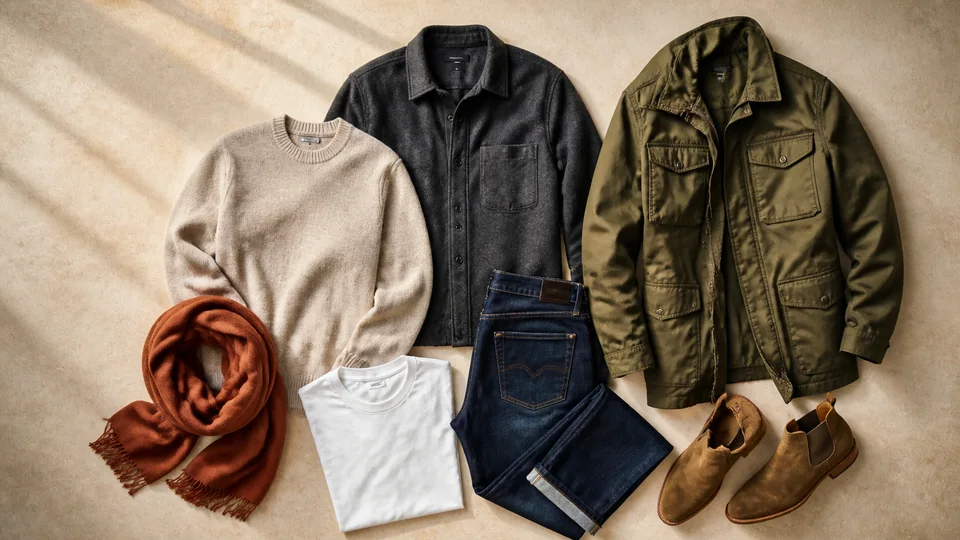
Fall dressing can feel complicated because a single day often asks more of an outfit than one season should. The morning is cool, the train or office is warm, the afternoon brightens, and a late walk brings the chill back. The answer is not to wear every knit you own. It is to build a small system of pieces that can be added, removed, and tied together without making the outfit lose its shape.
The most useful layered outfits begin with a dependable base, add one layer that changes the silhouette, and finish with an outer piece only when it earns its place. Start with clothes you already reach for: a T-shirt, button-down, fine knit, straight-leg jeans, relaxed trousers, a light jacket, or a coat. Then use the formulas below to make them work harder.
Give each layer a job
Before adding a third piece, decide what each one contributes. The base layer should be comfortable enough to wear on its own. A cotton T-shirt, fitted tank, lightweight long-sleeve top, or simple shirt does this quietly. The middle layer usually supplies texture or a change in line: a cardigan, overshirt, fine-gauge sweater, waistcoat, or open shirt. The outer layer handles the forecast and gives the outfit its finish.
This order also keeps proportions easy to read. If the base is close to the body, a roomier overshirt or cardigan can sit over it without bunching. If your trousers are wide or your skirt has volume, choose a middle layer with some structure or a length that stops near the waist. There is no universal rule about slim versus oversized; the useful question is whether you can still see a clear outline somewhere in the look.
Keep the fabric weights compatible. A crisp poplin shirt under a dense wool sweater can work, but a chunky knit under a tight denim jacket often feels cramped. Fine knits, jersey, chambray, merino, cotton twill, and light quilted layers make a flexible early-fall group. Save the heaviest coat for the moment it is actually needed.
Six fall layering formulas to repeat
1. T-shirt + open overshirt + straight jeans
This is the simplest place to start. Wear a white, cream, charcoal, or striped T-shirt under an unbuttoned overshirt, then add straight jeans and sturdy sneakers or ankle boots. Let the T-shirt collar and hem show slightly so the layers look deliberate. An olive, navy, brown, or charcoal overshirt gives enough contrast without asking you to coordinate several bright colors.
2. Fine knit + trench or mac + tailored trousers
For a neater weekday outfit, begin with a lightweight crewneck or mock neck and tailored trousers. A trench coat or simple mac adds a long vertical line, which is especially helpful over relaxed trousers. Keep the shoes clean and understated: loafers, leather sneakers, flat boots, or a low heel all fit. If the knit is neutral, use a bag, belt, or scarf to add one controlled accent.
3. Button-down + cardigan + dark denim
A button-down shirt gives this formula a little crispness while a cardigan makes it feel relaxed. Wear the shirt collar open or buttoned closer to the neck; both work, but choose one rather than halfway. A shorter cardigan creates a clear waist with high-rise denim, while a longer cardigan looks easy with a straighter, lower-contrast jean. Roll one cuff only if it improves the shape; otherwise let the sleeves stay simple.
4. Tank or tee + blazer + relaxed trousers
A blazer does not need a formal destination. A soft-shouldered blazer over a plain base layer gives wide trousers or drapey pants some structure. Match the visual weight of the footwear to the trousers: a substantial loafer, sleek trainer, or boot usually balances better than a very delicate shoe. If you remove the blazer indoors, the tank or tee should still feel like a complete top.
5. Long-sleeve top + vest + utility jacket
For outdoor plans, use a thin long-sleeve top as the base, then add either a light quilted vest or a utility jacket rather than both at full volume. If you use the vest, leave the jacket open and keep its color quiet. This makes a practical outfit from familiar pieces without turning the torso into a stack of bulky panels. Jeans, cargo trousers, or a simple knit skirt all give the top half a grounded partner.
6. Dress or skirt + knit + boots
Layering is not limited to trousers. Put a fine knit over a slip, shirt, or knit dress, and use a belt only if you want to bring the waist back into view. With a skirt, choose a sweater length that either ends clearly above the waistband or is tidy enough to half-tuck. Knee-high boots, ankle boots, or refined sneakers can carry the look into cooler weather; the best choice is the pair you can comfortably walk in.
Keep color and texture calm
One of the easiest ways to make layers feel cohesive is to limit the palette before choosing individual pieces. Begin with two neutrals you already own, such as navy and cream, charcoal and denim, olive and ecru, or brown and black. Add one accent only if it gives the outfit energy: rust in a scarf, burgundy in a bag, or a small stripe near the face. Our guide to matching clothing colors can help you choose combinations when you are not sure where to begin.
Texture creates interest even when the colors stay quiet. Denim next to merino, a suede boot with cotton twill, or a smooth tee under brushed wool gives the eye something to notice. You do not need a new statement item for this. Repeating a small detail, such as warm leather at the belt and shoe, is often enough to make a practical outfit look considered.
Plan for the temperature change
Try the outfit on as a sequence, not just as a final mirror moment. Take off the outer layer. Does the middle layer still feel balanced? Take off that piece too. Is the base layer comfortable and appropriate for the setting? This quick test prevents the familiar problem of an outfit that only works when every piece stays on.
Make removal easy. Choose a jacket that can be folded over an arm, a scarf that fits in a bag, or an overshirt that can be tied neatly at the waist only if that feels natural for you. Avoid building the whole outfit around a layer that has nowhere to go. When weather is uncertain, the ability to adapt is more useful than trying to predict every degree.
Finally, edit one item out. If two layers offer the same function, keep the one with better fit or texture. The most successful fall outfits have breathing room: a visible neckline, a little sleeve, a clean trouser line, or enough contrast to distinguish each layer. For more ways to make familiar pieces feel fresh, see our guide to building outfits from clothes you already own.
A simple fall layering checklist
Use this short check before you leave: Can you remove the outer piece and still feel put together? Are the fabrics thin enough to sit comfortably together? Is there one clear silhouette rather than several competing volumes? Are your shoes right for the walking you will do? If the answer is yes, the outfit is ready. Fall layering works best when it supports your day instead of becoming the day’s main project.
Frequently asked questions
What is the easiest way to layer clothes for fall?
Start with a comfortable base such as a T-shirt or fine knit, add one middle layer like a cardigan or overshirt, and keep a light jacket for outside. Make sure each piece still works when another layer comes off.
How do I layer without looking bulky?
Use lighter fabrics near the body, add volume in only one place, and keep a clear outline at the waist, shoulder, or ankle. Avoid stacking several thick layers with the same length.
Which colors work well for fall layering?
Build from two neutrals such as navy and cream, charcoal and denim, or olive and ecru. Add a single accent such as rust, burgundy, or mustard if you want more contrast.
What should I wear when it is cold in the morning and warm later?
Choose a base layer you are happy to wear indoors, then add a removable overshirt, cardigan, or light jacket. Pick pieces that can be folded or carried easily once the temperature rises.